
Sarajevo severe fine aerosol burden: A European pollution hotspot
Marta Via, Benjamin Chazeau, Asta Gregoriˇc, Michael Bauer, Kristina Glojek, Petra Makori, Iasonas Stavroulas, Jay Slowik, Martin Rigler, Philip Croteau, Leah Williams, John Jayne, Kaspar R. Daellenbach, Almir Bijedi, Enis Omer, Enis Kreˇcini, Dragana Đorđevii, Sanja Frkaj, Andr´e S.H. Pr´evot, Katja Dˇzepina
Environment International
Environment International,
Volume 214, 2026, 110367
Publication Date: June 14, 2026 Online
© Open Access. This work is distributed under
the Creative Commons Attribution 4.0 License.
Abstract.
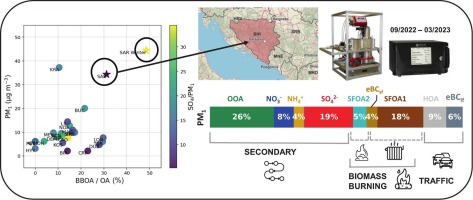
Sarajevo is the most PM2.5-polluted European capital (IQAir Report, 2024); however, fine aerosol measurements’ studies in the city are scarce. This study presents the results of an 8-month campaign in Sarajevo site focusing on organic aerosol (OA) and equivalent black carbon (eBC) and their respective sources. The mean PM1 campaign concentration in Sarajevo is 34.2 μg·m−3 with significantly higher contributions in winter stagnation episodes during which daily concentrations can exceed 100 μg·m−3. Furthermore, the number of daily PM1 concentrations during this 8-month campaign exceeding the EU legislation PM2.5 limit value are more than 4 times the stated maximum number of days per year. The eBC sources consist of liquid fuel (eBClf, 62%), and solid fuel (eBCsf, 38%) combustion, the latter proportion being higher than in other European sites. OA source apportionment results revealed 4 factors: hydrocarbon-like OA (HOA, 15%), two solid fuel combustion OA (SFOA1, 31%; SFOA2, 9%), and oxygenated OA (OOA, 44%). HOA and eBClf are related to traffic emissions; SFOA1, SFOA2, and eBCsf are associated with residential heating, although SFOA2 potentially reflects additional regional combustion sources; and OOA shows regional, secondary aerosol characteristics with biomass burning emissions influence. Accordingly, Sarajevo’s burden from air pollution could lead to all-cause mortality on the order of 10% during its heavy-polluted episodes. Overall, the submicron aerosol in Sarajevo constitutes a hotspot of fine aerosol pollution in comparison to other European sites both in its absolute concentrations and its relative proportion of biomass burning and SO42−, making this hotspot more comparable to those observed in other global hotspots than to typical European urban backgrounds.