
Variability in the Universality of Electron Ionization Mass Spectrometry Response to Oxygenates in Complex Environmental Mixtures
Purushottam Kumar, Chenyang Bi, Brian Lerner, John Jayne, Manjula R. Canagaratna,and Gabriel Isaacman-VanWertz
Analytical Chemistry
Anal. Chem. 2025, 97, 50, 27537–27543
Publication Date: December 8, 2025
https://doi.org/10.1021/acs.analchem.5c04153
Copyright © 2025 The Authors. Published by American Chemical Society. This publication is licensed under CC-BY 4.0.
Abstract.
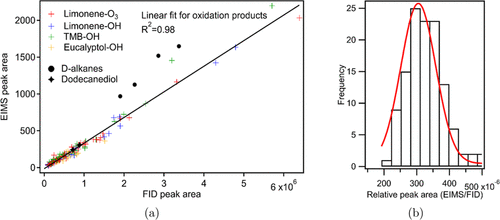
Electron ionization mass spectrometry (EIMS) has been widely used to measure complex atmospheric and environmental mixtures. The sensitivity of analytes in EIMS is typically obtained through a multipoint calibration curve using commercially available standards, but many analytes of interest do not have pure compounds available, and many samples contain a large fraction of unidentified compounds. To address these limitations in quantification, those analytes are often calibrated using a small number of standards with chemical similarities (e.g., shared functional groups). However, little systematic data are available on the variability of EIMS response factors to environmental analytes. In this work, we compare the EIMS response with a flame ionization detector (FID), a near-universal detector for organics, to quantify the variability in EIMS sensitivity to organics in a complex atmospheric mixture, particularly secondary organic aerosols (SOA). Particle-phase oxidation products from four precursor–oxidant pairs were produced, sampled, and analyzed by gas chromatography using a Thermal Desorption Aerosol Gas Chromatograph (TAG) with simultaneous detection by both FID and EIMS. The signals of FID and EIMS are highly correlated across the chromatogram, and peak areas of individual chromatographic peaks measured by both detectors are also closely correlated. The sensitivity of EIMS varies on average by ∼21% relative to FID for peak-by-peak comparison of oxygenated organic compounds within a complex mixture, suggesting that as long as some information is available about an unknown sample to categorize the analytes in the sample, an EIMS can be treated as a universal detector calibrated using chemically similar analytes.