
Alicia Hoffman, Rachel L. James, Dwayne E. Heard, Lisa Whalley, Daniel Stone, Samuel Seldon, Jochen Stutz, Jonas Kuhn, Sol Cooperdock, Brice Temime-Roussel, Amna Ijaz, Barbara D’Anna, Kathy S. Law, Slimane Bekki, Fangzhou Guo, James Flynn, James M. St Clair, Meeta Cesler-Maloney, William R. Simpson, and Steve R. Arnold
Environmental Science and Technology Air
ACS EST Air (2026) 3 (10): 2827–2842.
Publication Date: September 12, 2026 (online)
© Open Access – Creative Commons CC BY 4.0
Abstract.
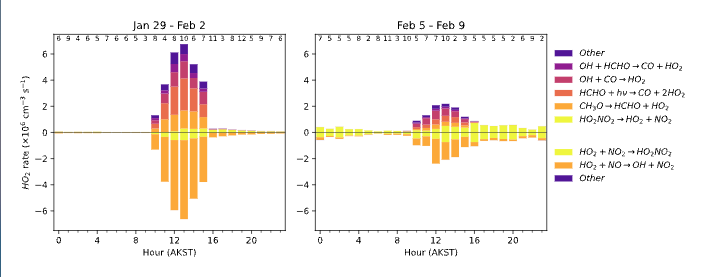
The hydroxyl radical (OH) is a key atmospheric oxidant that is important for regulating pollutant concentrations and particle formation and composition. The globally dominant formation mechanism of OH is ozone photolysis. However, the low-light conditions in the wintertime Arctic may limit OH formation through this pathway, and there is a lack of observations available to explain oxidant chemistry in polar locations. We use the Dynamically Simple Model of Atmospheric Chemical Complexity (DSMACC) 0D model to assess processes controlling the abundances of atmospheric oxidants in a subarctic city. To constrain the model, we use measurements made during the Alaskan Layered Pollution and Chemical Analysis (ALPACA) field campaign, which took place in Fairbanks, Alaska, USA, during the winter of 2022. HONO photolysis to form OH is the major chemical source of HOx in the polluted, low-light environment of wintertime Fairbanks, and formaldehyde is an important precursor for HO2. We find that the HOx budget is distinct between a polluted, strongly stable inversion event and a clean, weakly stable period because of the different meteorology and pollution levels regulating peroxynitric acid (PNA, HO2NO2) cycling. Our results improve our understanding of the unique atmospheric pollution chemistry under cold and low-light conditions.