
Methanethiol and dimethyl sulfide measurements in seawater and the atmosphere around the Antarctic Peninsula and in the Weddell Sea
Charel Wohl, Leah R. Williams, Elisabeth S. M. Deschaseaux, Lauriane L. J. Quéléver, David C. S. Beddows, Harald Stark, Veronika Pospisilova, Felipe D. Lopez-Hilfiker, Guillaume Chamba, Karine Sellegri, Elisabet L. Sà, Queralt Güell-Bujons, Magda Vila, Yaiza M. Castillo, Arianna Rocchi, Ana Sotomayor, Dolors Vaqué, Manuel Dall’Osto, Elisa Berdalet, and Rafel Simó
Atmospheric Chemistry and Physics
Atmos. Chem. Phys., 26, 10149–10165
Publication Date: July 21, 2026
© Author(s) 2026. This work is distributed under the Creative Commons Attribution 4.0 License.
Abstract.
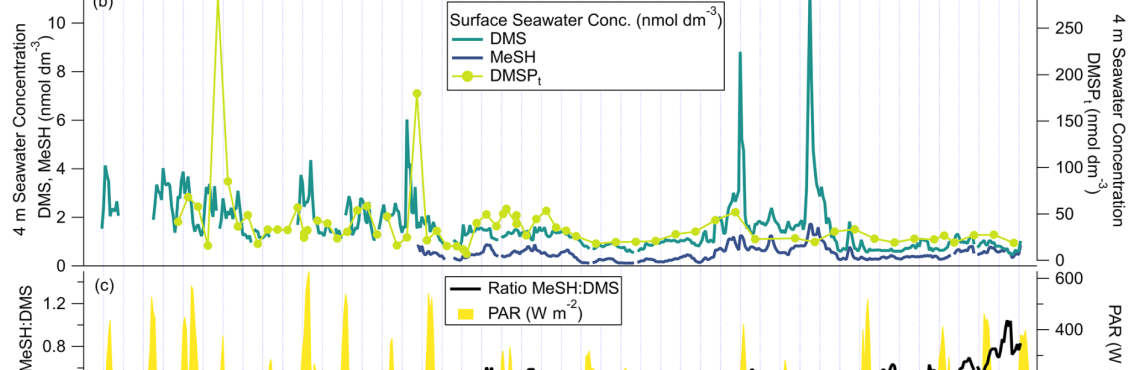
Inclusion of methanethiol (MeSH) in global atmospheric chemistry–climate model assessments has shown that MeSH emissions increase SO2, particulate sulfate and aerosol cooling over the Southern Ocean. However, measurements in the Southern Ocean are sparse. In February and March 2023, we deployed three online high-resolution mass spectrometers to measure MeSH and dimethyl sulfide (DMS) in seawater (down to 100 m in depth) and air during a cruise on the west side of the Antarctic Peninsula and in the Weddell Sea. MeSH concentrations in surface seawater (mean 0.5, range 0.11 to 1.7 nmol dm−3) were within the range previously reported for polar and subpolar regions. Considering concurrent DMS seawater concentrations (mean 1.6, range 0.45 to 11.3 nmol dm−3), MeSH represented 28±8 % of the ocean’s volatile methylated sulfur (VMS = DMS + MeSH). Depth profiles of MeSH showed higher concentrations in the euphotic layer. Sea to air fluxes of MeSH (mean 0.9, range 0.03 to 4.3 µmol m2 d−1) were comparable to those of DMS (mean 1.7, range −0.6 to 8.6 µmol m2 d−1). Ambient air MeSH (mean 0.015, range 0.001 to 0.060 ppbv) was low and similar to other observations. Air DMS concentrations were about a factor of 10 higher than MeSH (mean 0.25, range 0.008 to 1.35 ppbv) and there was excellent agreement between two different instruments using different ionization chemistries. MeSH seawater concentrations, sea–air fluxes, and atmospheric mixing ratios displayed depletion during daytime. Overall, this dataset represents a useful resource for model integration and validation.