
Investigating fire-induced ozone production from local to global scales
Joseph O. Palmo, Colette L. Heald, Donald R. Blake, Ilann Bourgeois, Matthew Coggon, Jeff Collett, Frank Flocke, Alan Fried, Georgios Gkatzelis, Samuel Hall, Lu Hu, Jose L. Jimenez, Pedro Campuzano-Jost, I-Ting Ku, Benjamin Nault, Brett Palm, Jeff Peischl, Ilana Pollack, Amy Sullivan, Joel Thornton, Carsten Warneke, Armin Wisthaler, and Lu Xu
Atmospheric Chemistry and Physics
Atmos. Chem. Phys., 25, 17107–17124
Publication Date: November 28, 2025
© Author(s) 2025. This work is distributed under
the Creative Commons Attribution 4.0 License.
Abstract.
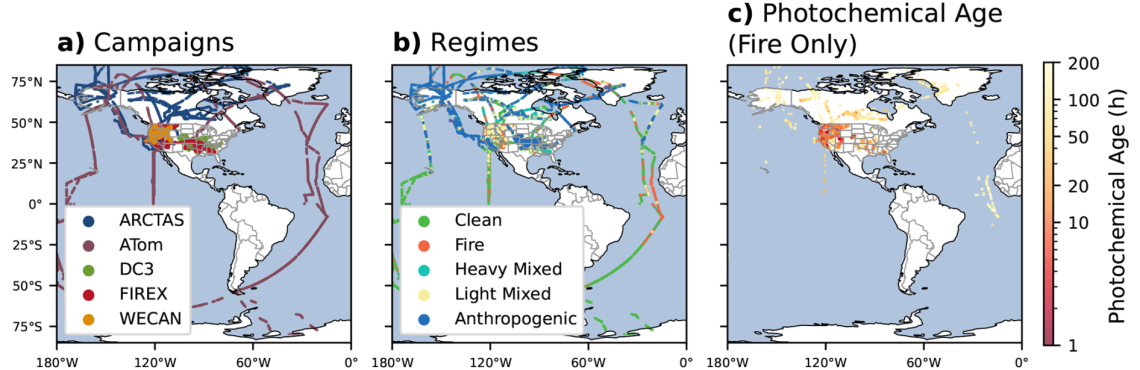
Tropospheric ozone (O3) production from wildfires is highly uncertain; previous studies have identified both production and loss of O3 in fire-influenced air masses. To capture the total ozone production attributable to a smoke plume, we bridge the gap between near-field fire plume chemistry and aged smoke in the remote troposphere. Using airborne measurements from several major campaigns, we find that fire-ozone production increases with age, with a regime transition from NOx-saturated to NOx-limited conditions, showing that O3 production in well-aged plumes is largely controlled by nitrogen oxides (NOx). Observations in fresh smoke demonstrate that suppressed photochemistry reduces O3 production by ∼ 70 % in units of ppb Ox (O3 + NO2) per ppm CO in the near-field (age < 20 h). We demonstrate that anthropogenic NOx injection into VOC-rich fire plumes drives additional O3 production, sometimes exceeding 50 ppb above background. Using a box model, we explore the evolving sensitivity of O3 production to fire emissions and chemical parameters. We demonstrate the importance of aerosol-induced photochemical suppression over heterogeneous HO2 uptake, validate HONO’s importance as an oxidant precursor, and confirm evolving NOx sensitivity. We evaluate GEOS-Chem’s performance against these observations, finding the model captures fire-induced O3 enhancements at older ages but overestimates near-field enhancements, fails to capture the magnitude and variability of fire emissions, and does not capture the chemical regime transition. These discrepancies drive biases in normalized ozone production (ΔO3/ΔCO) across plume lifetime, though the model generally captures observed absolute O3 enhancements in fire plumes. GEOS-Chem attributes 2.4 % of the global tropospheric ozone burden and 3.1 % of surface ozone concentrations to fire emissions in 2020, with stronger impacts in regions of frequent burning.
Tropospheric ozone (O3) production from wildfires is highly uncertain; previous studies have identified both production and loss of O3 in fire-influenced air masses. To capture the total ozone production attributable to a smoke plume, we bridge the gap between near-field fire plume chemistry and aged smoke in the remote troposphere. Using airborne measurements from several major campaigns, we find that fire-ozone production increases with age, with a regime transition from NOx-saturated to NOx-limited conditions, showing that O3 production in well-aged plumes is largely controlled by nitrogen oxides (NOx). Observations in fresh smoke demonstrate that suppressed photochemistry reduces O3 production by ∼ 70 % in units of ppb Ox (O3 + NO2) per ppm CO in the near-field (age < 20 h). We demonstrate that anthropogenic NOx injection into VOC-rich fire plumes drives additional O3 production, sometimes exceeding 50 ppb above background. Using a box model, we explore the evolving sensitivity of O3 production to fire emissions and chemical parameters. We demonstrate the importance of aerosol-induced photochemical suppression over heterogeneous HO2 uptake, validate HONO’s importance as an oxidant precursor, and confirm evolving NOx sensitivity. We evaluate GEOS-Chem’s performance against these observations, finding the model captures fire-induced O3 enhancements at older ages but overestimates near-field enhancements, fails to capture the magnitude and variability of fire emissions, and does not capture the chemical regime transition. These discrepancies drive biases in normalized ozone production (ΔO3/ΔCO) across plume lifetime, though the model generally captures observed absolute O3 enhancements in fire plumes. GEOS-Chem attributes 2.4 % of the global tropospheric ozone burden and 3.1 % of surface ozone concentrations to fire emissions in 2020, with stronger impacts in regions of frequent burning.