
The determination of ClNO2 via thermal dissociation–tunable infrared laser direct absorption spectroscopy
John W. Halfacre, Lewis Marden, Marvin D. Shaw, Lucy J. Carpenter, Emily Matthews, Thomas J. Bannan, Hugh Coe, Scott C. Herndon, Joseph R. Roscioli, Christoph Dyroff , Tara I. Yacovitch, Patrick R. Veres, Michael A. Robinson, Steven S. Brown, and Pete M. Edwards
Atmospheric Measurements Techniques
Atmos. Meas. Tech., 18, 3799–3818
Publication Date: August 12, 2025
© Author(s) 2025. This work is distributed under
the Creative Commons Attribution 4.0 License.
Abstract.
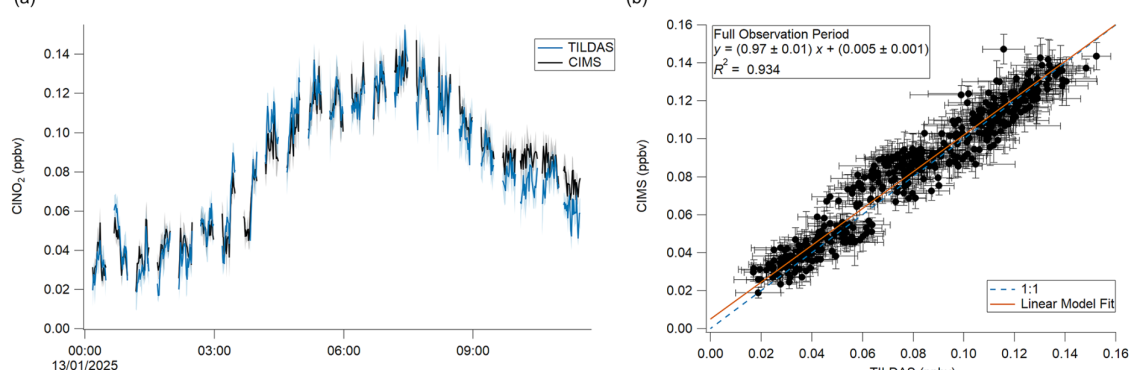
Nitryl chloride (ClNO2,) is a reservoir species of chlorine atoms and nitrogen oxides, both of which play important roles in atmospheric chemistry. To date, all ambient ClNO2 observations have been obtained by chemical ionization mass spectrometry (CIMS). In this work, thermal dissociation–tunable infrared laser direct absorption spectrometry (TD-TILDAS) is shown to be a viable method for quantifying ClNO2 in laboratory and field settings. This technique relies on the thermal dissociation of ClNO2 to create chlorine radicals, which undergo fast reactions with hydrocarbons to produce hydrogen chloride (HCl) that is detectable by the TILDAS instrument. Complete quantitative conversion of ClNO2 to HCl was achieved at temperatures > 400 °C, achieving 1 Hz measurement precision of 11 ± 1 pptv (3σ limits of detection of 34 ± 2 pptv) during laboratory comparisons with other ClNO2 detection methods. After blank and line loss corrections, method accuracy is estimated to be within ± 5 %. Performance metrics of TD-TILDAS during ambient sampling were a 1 Hz precision of 19 ± 1 pptv and 3σ limits of detection of 57 ± 3 pptv, which is directly comparable to previously reported ClNO2 detection by quadrupole CIMS. Thus, TD-TILDAS can provide an alternative analytical approach for a direct measurement of ClNO2 that can complement existing datasets and future studies. The quantitative nature of TD-TILDAS also makes it a potentially useful tool for the calibration of CIMS instruments. However, interpretation of ambient data may be complicated by potential interferences from unaccounted-for sources of thermolabile chlorine, such as ClNO, chloramines, and organochlorides.
Nitryl chloride (ClNO2,) is a reservoir species of chlorine atoms and nitrogen oxides, both of which play important roles in atmospheric chemistry. To date, all ambient ClNO2 observations have been obtained by chemical ionization mass spectrometry (CIMS). In this work, thermal dissociation–tunable infrared laser direct absorption spectrometry (TD-TILDAS) is shown to be a viable method for quantifying ClNO2 in laboratory and field settings. This technique relies on the thermal dissociation of ClNO2 to create chlorine radicals, which undergo fast reactions with hydrocarbons to produce hydrogen chloride (HCl) that is detectable by the TILDAS instrument. Complete quantitative conversion of ClNO2 to HCl was achieved at temperatures > 400 °C, achieving 1 Hz measurement precision of 11 ± 1 pptv (3σ limits of detection of 34 ± 2 pptv) during laboratory comparisons with other ClNO2 detection methods. After blank and line loss corrections, method accuracy is estimated to be within ± 5 %. Performance metrics of TD-TILDAS during ambient sampling were a 1 Hz precision of 19 ± 1 pptv and 3σ limits of detection of 57 ± 3 pptv, which is directly comparable to previously reported ClNO2 detection by quadrupole CIMS. Thus, TD-TILDAS can provide an alternative analytical approach for a direct measurement of ClNO2 that can complement existing datasets and future studies. The quantitative nature of TD-TILDAS also makes it a potentially useful tool for the calibration of CIMS instruments. However, interpretation of ambient data may be complicated by potential interferences from unaccounted-for sources of thermolabile chlorine, such as ClNO, chloramines, and organochlorides.